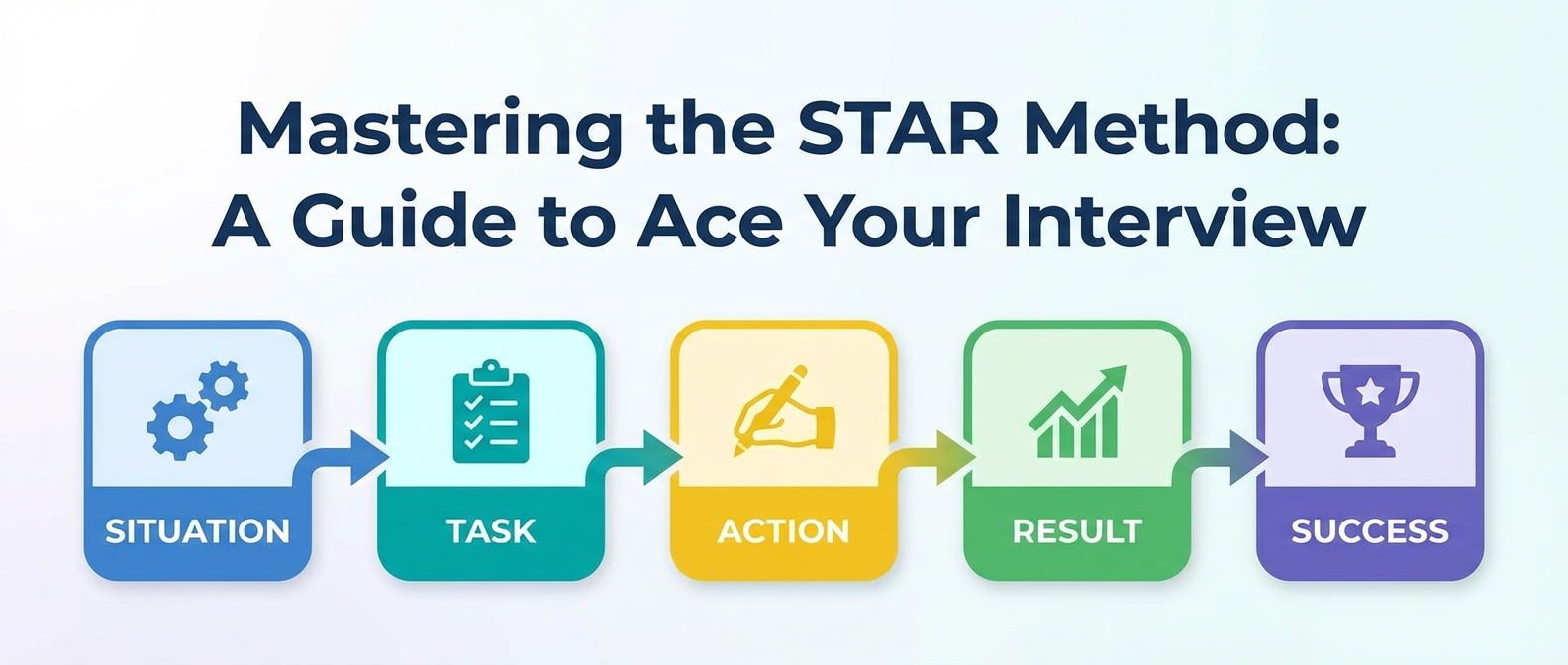
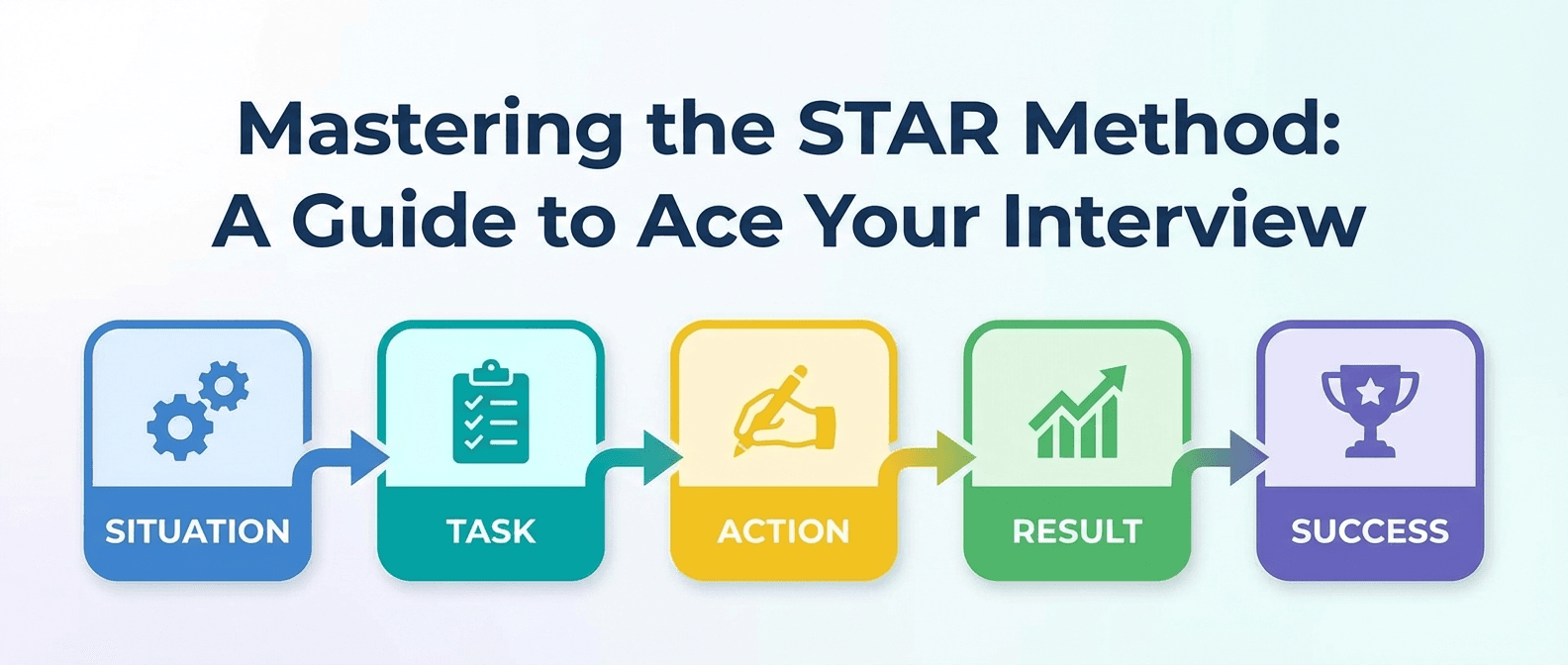
Behavioral interview questions are the ones that start with "Tell me about a time when..." or "Give me an example of..." They're common in almost every interview, and a lot of people handle them badly - not because they lack good stories, but because they don't have a clear structure.
The STAR method gives you that structure. It won't make you sound robotic if you use it right. Think of it as a mental checklist, not a script.
What STAR Stands For
S - Situation: Set the scene. Where were you, what was the context, and what was the challenge?
Want to practice what you just read?
Answer a real interview question and get AI feedback in a couple of minutes.
T - Task: What exactly were you responsible for? What was your role?
A - Action: What did you actually do? This is the heart of your answer.
R - Result: What happened? What was the outcome of your actions?
Simple enough. The reason people still mess it up is that they misweight these four parts.
How Much Time to Spend on Each Part
Here's the rough breakdown that works well in most interviews:
- Situation: 10-15% of your answer
- Task: 10-15%
- Action: 60-70%
- Result: 15-20%
The action is where your answer lives. That's where the interviewer learns how you think and operate. The situation is just context - they don't need a three-paragraph backstory about your company's organizational structure.
This is also the most common mistake: spending too long on the setup and running out of time before you get to what you actually did.
Breaking Down Each Component
Situation
Keep it brief. One or two sentences that give the interviewer just enough context to understand why this situation mattered.
Bad: "So I was working at this company, and we had just gone through a reorganization, and my team had changed, and we were using a new project management system, and our manager was new too, and we were trying to figure out how to work together..."
Good: "We had a product launch coming up in six weeks and the engineering team had just flagged a critical bug that could delay the whole thing."
Task
This is where you clarify your specific role. Were you the lead? A contributor? The only person who knew how to fix it? Be specific about ownership.
"As the project manager, I was responsible for figuring out whether we could still make the deadline or whether we needed to reset expectations with the client."
Action
This is where most people get vague. They say things like "I coordinated with the team" or "I took steps to resolve the issue." That tells an interviewer nothing.
Break down what you actually did. What decisions did you make? What did you say to people? What did you build, write, or change?
"I called an emergency meeting with the engineering lead to understand exactly what was broken. We mapped out three scenarios: delay the launch by two weeks, launch with the bug and patch it post-launch, or scope down the feature set to something shippable. I put together a one-pager outlining the tradeoffs for each and brought it to the VP. We agreed on the scoped-down launch. I then updated the client directly, ahead of them hearing it secondhand, and walked them through what would still be included."
See how specific that is? The interviewer can actually picture what happened.
Result
This is the second most common failure point. People either forget to include results, give vague results ("things went well"), or fail to quantify when they could.
Whenever you can attach a number, do it. Not because interviewers are obsessed with metrics, but because specificity makes your story credible.
"We launched on time. The client was frustrated about the feature cut but appreciated the transparency. Three weeks after launch, we shipped the missing features, and the client renewed their contract."
If the result wasn't entirely positive, that's okay. Honest stories with lessons learned often land better than suspiciously perfect outcomes.
A Full Example, Put Together
Question: "Tell me about a time you had to manage a difficult stakeholder."
Answer using STAR:
"My company was building a new data reporting tool for our sales team. The VP of Sales - who was a key stakeholder - kept changing the requirements after we'd already started building. [Situation]
My job was to keep the project on track while making sure his team's real needs were being met. [Task]
I asked for a 30-minute meeting with him - not to argue about scope, but to understand what problem he was actually trying to solve. It turned out his original spec was based on an assumption that had changed. He didn't need the full reporting dashboard; he needed one specific metric that was fast and easy to pull up on mobile. I proposed a phased approach: we'd build that mobile-first view first, which we could do in three weeks, and then layer on the full dashboard over the next quarter. He agreed. I documented the new scope in writing and got his sign-off before we went back to the engineering team. [Action]
We shipped the mobile view on schedule. He was happy, the scope creep stopped, and we ended up delivering the full dashboard a month ahead of the revised timeline. [Result]"
That answer is tight, specific, and shows real judgment.
Common Mistakes to Avoid
Telling "we" stories instead of "I" stories. Interviewers want to know what you did. It's fine to mention your team, but the actions need to be yours. If you keep saying "we did this" and "we decided that," the interviewer has no idea what your actual contribution was.
Not quantifying the result. If you saved time, how much? If you increased revenue, by how much? If you improved a process, what changed? Numbers aren't everything, but they add credibility.
Picking a story that doesn't answer the question. Before you dive in, make sure your story actually demonstrates what they're asking about. If they ask about leadership and your story is really about problem-solving, pick a different story.
Rambling past three minutes. Most behavioral answers should take two to three minutes. Practice timing yourself. If you're going longer, you're probably spending too much time on Situation.
Not having enough stories prepared. If you have one good story for every question, you'll end up using the same story for everything. That's obvious and looks like you don't have much range. Prepare at least five or six solid stories that can flex across different question types.
How to Practice
Write them out first. Before you practice speaking, write out three to five stories in full STAR format. This forces you to be specific about the action component and figure out your actual results.
Record yourself. You don't need fancy equipment - your phone works. Watch it back and look for: Are you being specific? Are you using "I" or always "we"? Did you include a result? Are you under three minutes?
Prepare stories that work for multiple questions. A good leadership story might also work for conflict resolution or decision-making. Think about the qualities each story demonstrates and tag them accordingly.
Do a mock interview. Reading through questions alone is not the same as answering them out loud in real time. Practice with a friend, a career coach, or a mock interview tool that gives you feedback on your answers.
Questions to Practice
Here are common behavioral questions to get you started:
- Tell me about a time you failed and what you learned.
- Describe a situation where you had to make a decision without complete information.
- Give me an example of a time you dealt with a difficult coworker.
- Tell me about a time you went above and beyond what was expected.
- Describe a project you led from start to finish.
- Tell me about a time you had to change course mid-project.
For each of these, have a story ready that fits the STAR structure. Don't memorize the exact words - that sounds rehearsed. Know the story well enough that you can tell it naturally.
The STAR method works because it keeps you focused. It stops you from rambling, forces you to get specific about your own actions, and makes sure you're landing the result. Use it as a guide, not a cage - your answers should still sound like you.
Vidal Graupera
February 1, 2026